When buying or selling a home in North Carolina, understanding who your real estate agent represents is important. This can become more complicated when the same real estate firm represents both the buyer and seller.
Dual agency and designated dual agency both allow one firm to represent clients on both sides of a transaction, but they work differently. Understanding that difference can help you decide what type of representation you are comfortable with.

Key Takeaways
- Dual agency occurs when the same real estate firm represents both the buyer and seller, even if they are working with different individual agents.
- In traditional dual agency, the agents must treat both parties fairly and equally and cannot help either party gain an advantage.
- Designated dual agency allows separate agents within the same firm to advocate for their respective clients.
What is Dual Agency?
If you are wondering about dual agency in real estate, it occurs when the same real estate firm represents both the buyer and seller in a transaction. This can happen when one agent lists a property and another agent from the same firm represents the buyer who wants to purchase it.
Even though the buyer and seller may be working with different individual agents, the firm is representing both parties. Unless designated dual agency is used, the agents are dual agents who must treat the buyer and seller fairly and equally and cannot help either party gain an advantage over the other.
In practice, this limits the advice the agents can provide during negotiations, including advice intended to give one client an advantage on price or terms. Both the buyer and seller must consent in writing to dual agency in North Carolina.
What is Designated Dual Agency?
Designated dual agency provides a different option when the same firm represents both sides of a transaction. The firm remains in dual agency, but one designated agent is assigned to represent the buyer and another is assigned to represent the seller.
Unlike traditional dual agency, each designated agent can focus on their own client’s interests and more fully represent that client. This allows the agents to provide advice and advocacy to their respective clients while keeping confidential information protected.
At our firm, the broker-in-charge oversees the designated dual agency process and is available to help agents with questions about agency rules, confidentiality, or how the transaction should be handled. This allows the buyer and seller to have separate representation within the same firm while maintaining oversight of the agency arrangement.

Differences Between Designated Dual and Dual Agency
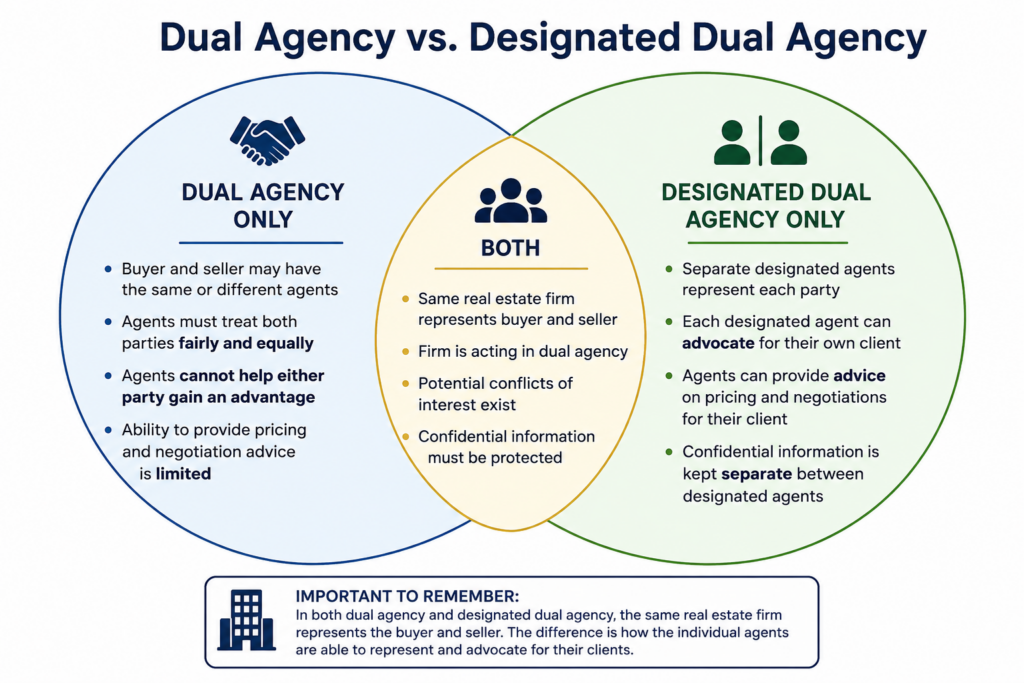
The biggest difference is not whether the buyer and seller have two different agents. The important distinction is whether those agents are acting as dual agents or have been designated to exclusively represent their individual clients.
Dual Agency Only
- Buyer and seller may have the same or different agents
- Agents must treat both parties fairly and equally
- Agents cannot help either party gain an advantage
- Ability to provide pricing and negotiation advice is limited
Both
- Same real estate firm represents buyer and seller
- Firm is acting in dual agency
- Potential conflicts of interest exist
- Confidential information must be protected
Designated Dual Agency Only
- Separate designated agents represent each party
- Each designated agent can advocate for their own client
- Agents can provide advice on pricing and negotiations for their client
- Confidential information is kept separate between designated agents
The diagrams in the North Carolina Real Estate Commission’s Working With Real Estate Agents brochure provide another helpful way to visualize this distinction. In both dual agency and designated dual agency, the buyer’s and seller’s brokers work for the same brokerage company, while traditional buyer agency and seller agency involve brokers working for different companies.
Bottom Line
The biggest difference between dual agency and designated dual agency is the representation the individual agents can provide. Simply having two different agents at the same firm does not mean those agents can independently advocate for the buyer and seller unless designated dual agency has been established.
With designated dual agency, each party has a designated agent who can advocate for their interests, while the firm remains in dual agency. Before agreeing to either arrangement, buyers and sellers should understand who will represent them, what advice their agent can provide, and how confidential information will be handled.
At Altamont Property Group, we want buyers and sellers to understand their representation before making that decision. If you are buying or selling a home in Asheville or Western North Carolina, our team can explain your agency options and what they mean for your transaction.
Dual vs Designated Dual Agency FAQ
Does designated dual agency protect my confidential information?
Yes. A designated agent generally cannot disclose information such as their client’s negotiating position, motivation, or information the client has identified as confidential without permission, unless disclosure is otherwise required by law or rule.
Can I refuse dual agency when buying or selling a home in North Carolina?
Yes. You do not have to consent to dual agency in North Carolina. If you decline and a transaction would otherwise create dual agency, a different representation arrangement may be necessary.
Do buyers and sellers have to agree to dual agency in North Carolina?
Yes. Both the buyer and seller must consent in writing to dual agency. The agreement permitting dual agency must be in writing no later than the time the buyer makes an offer.
Can the same agent represent both the buyer and seller in a dual agency transaction?
Yes. With traditional dual agency, the same agent can represent both parties when dual agency has been properly authorized. However, the agent must treat both sides fairly and equally and cannot help one party gain an advantage over the other.
With designated dual agency, separate agents are assigned to represent the buyer and seller. Each designated agent can then advocate for their own client’s interests.
Should I agree to dual agency when buying or selling a home in Western North Carolina?
There is no single answer that is right for every buyer, seller, or transaction. Before agreeing, make sure you understand whether traditional or designated dual agency will be used, what advice your agent can provide, and how your confidential information will be protected.
What should I ask a real estate agent about dual agency before signing an agreement?
Ask what happens if the firm represents both sides of your transaction and whether the firm offers designated dual agency. You should also ask who will be able to advocate for you, what pricing and negotiation advice your agent can provide, how confidential information will be protected, and what role the broker-in-charge plays in the process.